
When a report sits in one spreadsheet, an investigation in another folder and actions in somebody’s inbox, the hardest question is often the simplest: what changed, and did it work?
Safetyman Sentinel brings reporting, investigation, risk analysis and assurance into a connected working environment. For a small business, that can mean clearer ownership. For a growing organisation, it can support a more consistent review process. For an enterprise, it offers a way to examine the evidence behind decisions across authorised workspaces.
This guide explains where the software can help, how to approach adoption and what to evaluate before choosing a solution. The images show Sentinel’s public demonstration with fictional records, not customer data or measured business results.
From a report to a verified improvement
A useful safety system should help people follow the reasoning, not simply count completed forms. Sentinel’s connected approach lets teams move from an event or observation to an investigation, consider the controls that matter, assign actions and examine whether the intended improvement has happened.
1. Capture the event and establish ownership
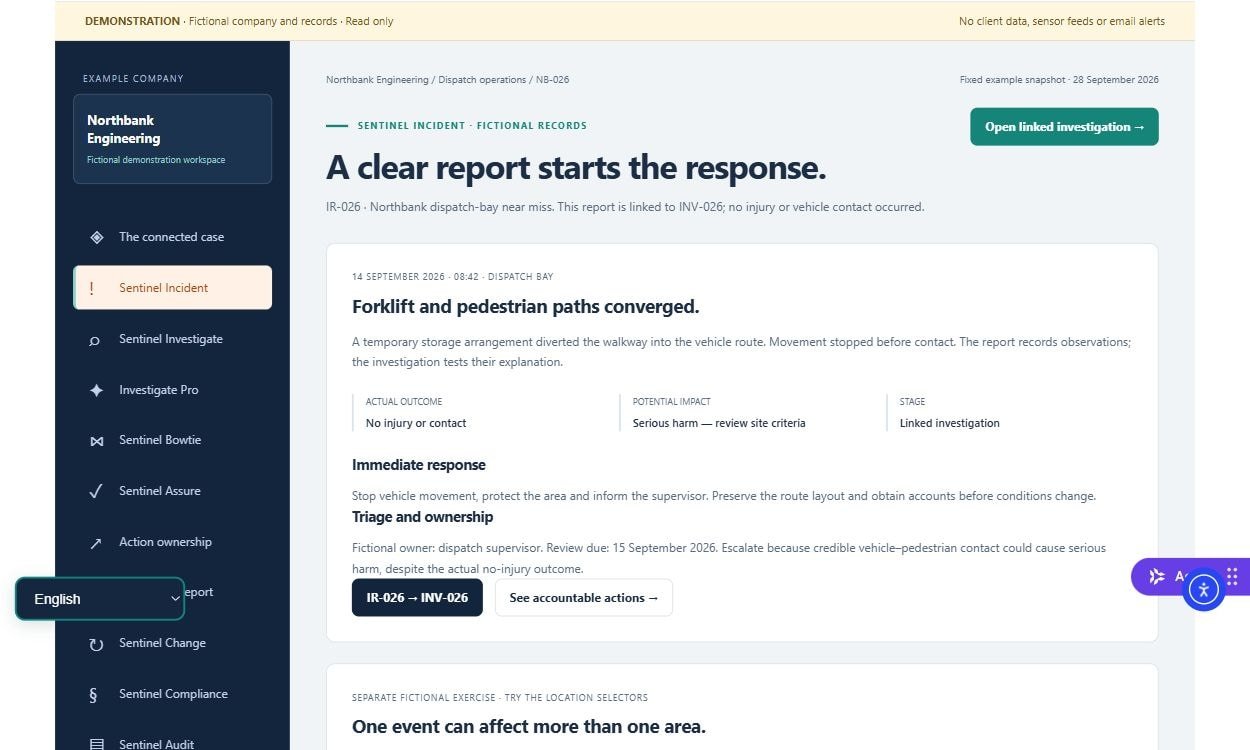
Incident supports recording near misses, injuries and illnesses, spills, property damage and vehicle incidents. A factual account, location, category, actual and potential impact, immediate response and named review owner help give the next person a clear starting point.
In the public demonstration, a temporary storage arrangement diverts a pedestrian route towards moving vehicles. No injury occurs, but the potential impact warrants review. This distinction matters: the absence of harm does not mean the conditions were acceptable.
2. Test explanations against evidence
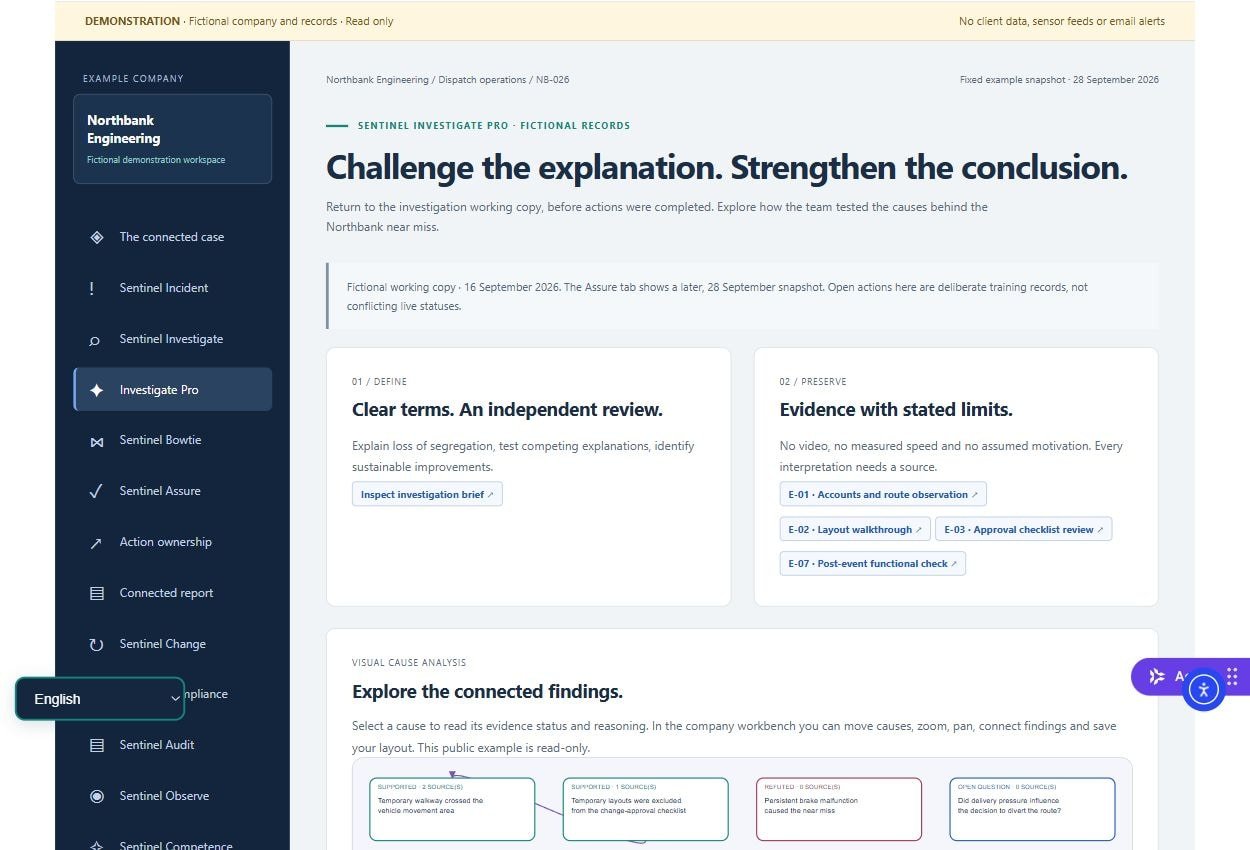
Investigate supports structured investigation using tools including 5 Whys, Why Trees, evidence and timelines. Investigate Pro extends this with an interactive causal canvas, hypotheses, supporting and contradicting evidence, barrier failure analysis and solution comparison.
The value is in making the reasoning inspectable. A plausible explanation remains a hypothesis until the evidence supports it. An unanswered question should remain visible. The software helps organise that work; it does not replace a competent investigator or independent review.
3. Understand which barriers need attention
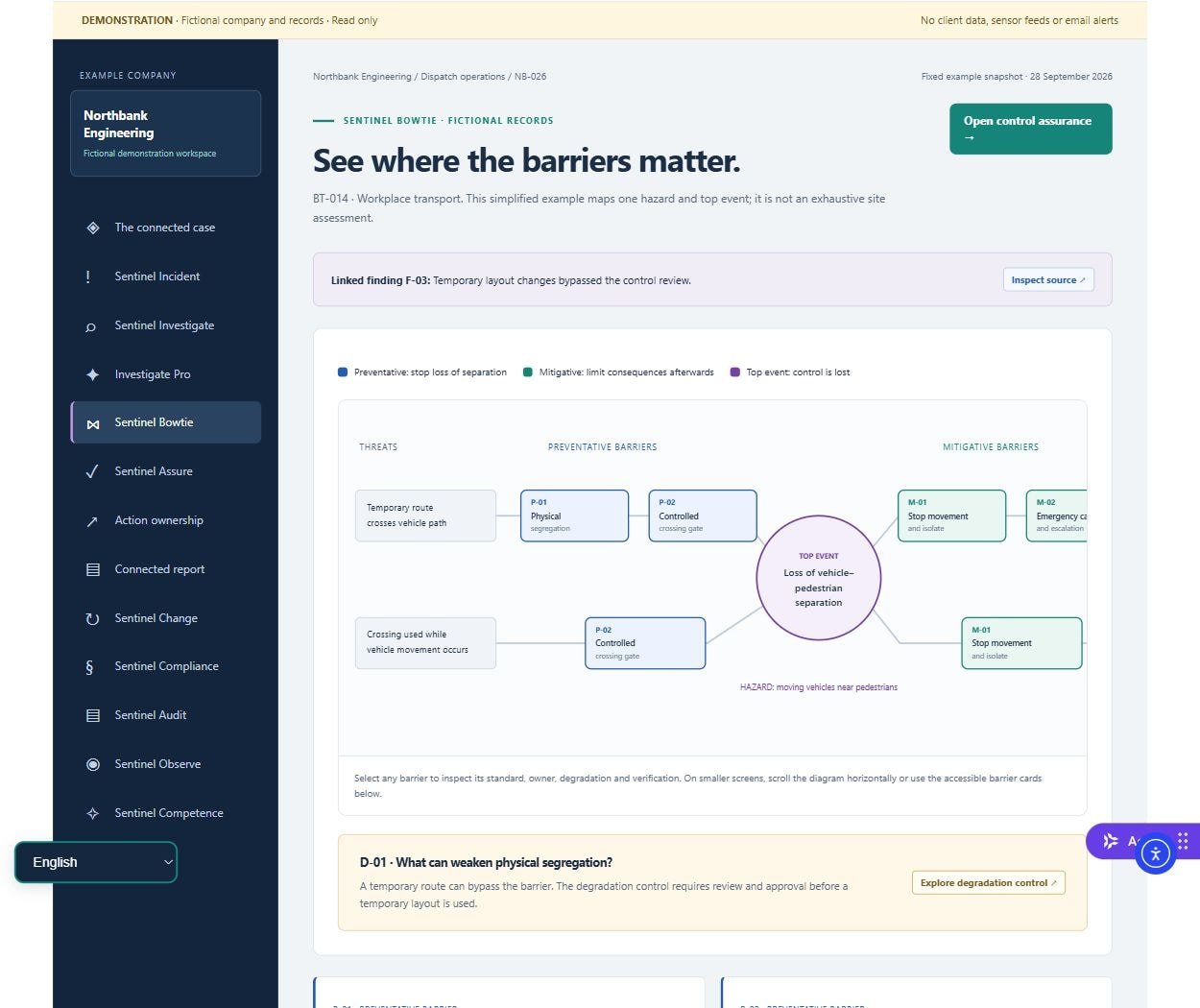
Bowtie brings threats, a top event, consequences and preventive and mitigative barriers into a visual model. Teams can consider how barriers might degrade and what supports their continued effectiveness. A supported investigation finding can inform a reviewed change to the model, rather than silently becoming an approved control.
4. Check effectiveness, not just completion
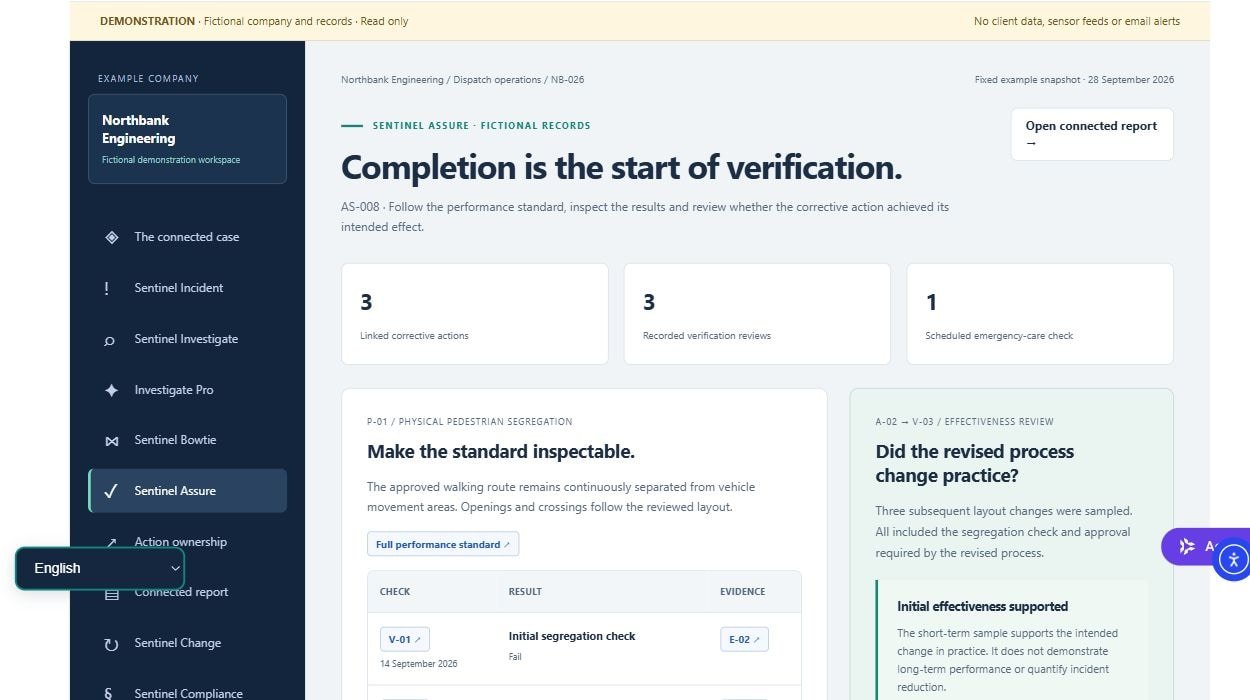
Assure supports control verification, inspections, action effectiveness, audits, findings and management reviews. An action owner can complete an activity, while a separate reviewer considers the evidence that it achieved its purpose.
In the demonstration, a revised layout-change process is checked against subsequent examples. A short-term sample supports an initial conclusion, with further checking still planned. This is more informative than treating a ticked box as proof of permanent improvement.
Small businesses: start with clarity, not complexity
In a smaller organisation, the person managing safety may also be managing operations, customers or people. A useful starting point is a narrow, repeatable process that makes it clear what needs attention, who owns it and when it will be reviewed.
For example, a workshop might begin with incident reporting and action follow-up. Instead of introducing every module immediately, it could agree a simple reporting standard, identify who reviews reports and reserve time each week to discuss outstanding actions and evidence.
- A clearer handover: factual records help avoid relying entirely on memory or informal conversations.
- Visible responsibility: named owners and due dates make the next step easier to understand.
- Proportionate investigation: review depth can reflect the event and its potential consequences.
- More focused training: recurring questions can inform a discussion about suitable learning, instruction or practical assessment.
A sensible first objective: every pilot report has a review owner, every agreed action has a due date, and closure includes an explanation of the evidence considered. These are proposed adoption measures, not promised software outcomes.
Growing organisations: make good practice easier to repeat
As a company adds supervisors, shifts or locations, differences in terminology and review habits can make information harder to compare. Sentinel can support a shared approach while keeping the operational context visible.
A growing distribution business, for example, might combine Incident and Investigate with Bowtie and Assure for selected high-priority activities. Teams could agree what a good report contains, which events require investigation and how an independent reviewer assesses completed actions.
- Consistent evidence expectations: reviewers can ask the same core questions while considering local circumstances.
- Connected follow-up: investigation findings can inform barrier reviews and verification activity.
- Controlled changes: Change supports review of affected barriers, readiness and temporary-change expiry.
- Learning from observations: Observe provides a route for hazards, positive control observations and improvement suggestions to receive a response.
The practical advantage is a more coherent process for teams to use together. Real results will depend on implementation, management attention, data quality and participation. Agree your measures before the pilot so that improvement can be evaluated honestly.
Enterprise teams: strengthen the evidence behind oversight
Larger organisations often need to understand how decisions were reached, which evidence supports them and what remains unresolved. An enterprise evaluation should therefore examine governance and review responsibilities as carefully as feature breadth.
Sentinel uses company membership and workspace roles to scope access. Its collaborative review approach includes decision history and handling overlapping changes. Trusted platform administrators manage the service. Organisations should validate their intended company structure and access model during evaluation rather than assume a particular cross-company reporting arrangement.
- Reviewable reasoning: supported, refuted and unanswered findings remain distinguishable.
- Independent scrutiny: action effectiveness and readiness for review are separate from approval.
- Traceable assurance: requirements, controls, evidence, gaps and reviewed conclusions can be considered together.
- Task-specific competence: training evidence can sit alongside practical assessment, restrictions and authorisation validity.
For enterprise procurement, discuss the required operating model, user numbers, hosting and support arrangements, data handling, retention, export needs and any integrations before committing. Do not assume that a public demonstration establishes a particular service level, security certification or capacity benchmark.
Choose modules around the decisions your people make
| Operational question | Relevant Sentinel capability |
|---|---|
| What happened, and who is reviewing it? | Incident: event accounts, impact, immediate response and ownership. |
| Which explanation does the evidence support? | Investigate and Investigate Pro: structured analysis, causal reasoning and review. |
| What prevents or limits the outcome? | Bowtie: threats, consequences, barriers and degradation factors. |
| Did the control or corrective action work? | Assure: verification, inspections and effectiveness reviews. |
| Is an operational change ready to proceed? | Change: affected barriers, readiness, ownership and post-implementation review. |
| What supports our compliance conclusion? | Compliance: requirement sources, scope, evidence, gaps and review. |
| What did our audit sample reveal? | Audit: checklists, evidence, findings, corrective actions and management review. |
| How do observations become useful responses? | Observe: hazards, positive observations, suggestions and triage. |
| Who is authorised for a particular task? | Competence: requirements, training, practical assessment and scoped authorisations. |
Compliance records support an organisation’s review; they do not automatically establish legal compliance or certification. Likewise, completing a course does not, by itself, establish competence for a practical task.
A practical route from demonstration to adoption
- Choose one problem. For example, reports lack ownership or actions close without effectiveness evidence.
- Map the current process. Identify the people, decisions, records and handovers involved.
- Try the public demonstration. Follow the fictional connected case and note the questions your team would need answered.
- Agree a limited pilot. Define scope, roles, review arrangements and the modules required.
- Prepare people as well as the system. Combine software familiarisation with suitable subject learning and local procedures.
- Review the evidence. Examine record quality, overdue actions and whether completed actions have a supported effectiveness conclusion.
- Expand deliberately. Add further workflows when the pilot demonstrates that people can use the agreed process consistently.
Useful pilot measures might include the proportion of reports with named reviewers, the age of overdue actions and the proportion of closed actions with verification evidence. Compare like-for-like periods and investigate changes in reporting behaviour before interpreting event counts.
Connect better systems with relevant learning
Safetyman Academy’s self-paced course library provides another part of the picture: the knowledge people bring to hazard identification, investigation and other workplace decisions. Live training at your premises or an agreed venue can also be discussed for a team’s requirements.
The Academy and Sentinel are complementary services. Automatic transfer of learning records, a shared subscription or a single sign-in should not be assumed. Read our guide to connecting learning with Sentinel and explore flexible training options.
Your questions answered
Can we try Sentinel before discussing a licence?
Yes. The public demonstration uses fictional, read-only records and can be explored without signing up.
Do we have to begin with every module?
Discuss the workflows you need first. The public plans describe annual named-user licences in blocks of ten, with quotation-based pricing. Investigate Pro extends Investigate; Audit is included with Assure or available separately. Confirm your precise package and current terms in a quotation.
Does Sentinel make safety decisions automatically?
No. Evidence, analysis and review support human decisions. Optional AI requires server configuration and deliberate selection of data; human review remains essential. Forecasting also depends on data-readiness and validation requirements and should not be treated as a pre-validated prediction of incidents.
How do we assess value?
Start with a defined operational problem and a baseline. Evaluate whether the agreed process improves the quality and timeliness of decisions. Do not rely on an assumed percentage saving or a guaranteed reduction in incidents.
Product information is based on the Sentinel website and public demonstration reviewed on 29 October 2026. Images show fictional teaching records. Availability, configuration and commercial terms should be confirmed for your proposed deployment.
Join the conversation
Comments are for registered users and are reviewed by an administrator before publication.